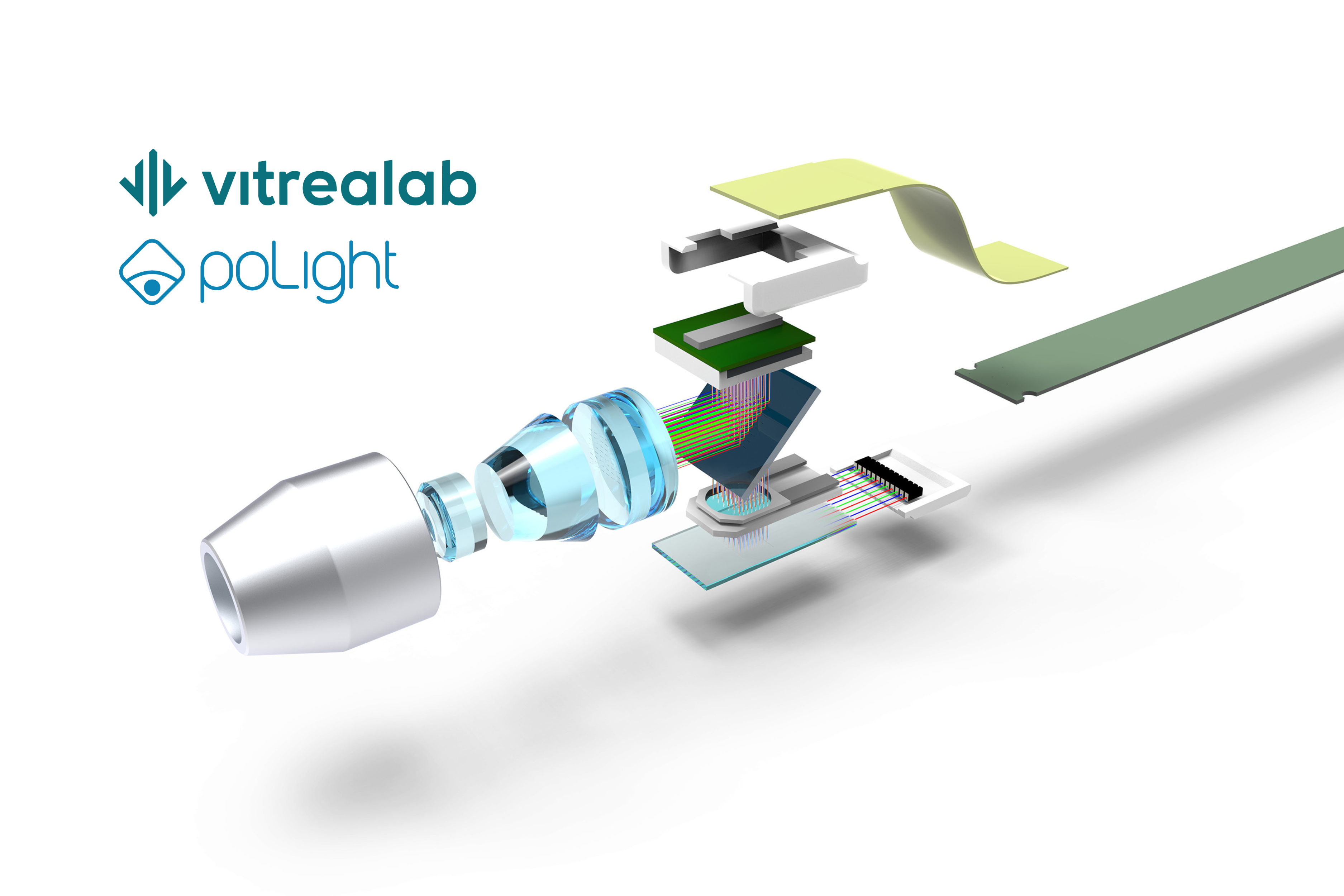
VIENNA, Austria and TØNSBERG, Norway – April 23, 2026 — Vitrealab GmbH and poLight ASA (OSE: PLT) today announced a collaboration to advance laser illumination architectures for LCoS-based augmented reality (AR) displays, with a focus on mitigating coherence-related image artifacts while preserving system efficiency and compactness.
Laser-based illumination offers clear system-level advantages for LCoS based AR light engines, including high optical efficiency due to intrinsic polarization, improved etendue utilization, and scalability to high brightness levels. However, coherence artifacts, manifesting as speckles and fringes, have remained a primary barrier to adoption in LCoS-based near-eye displays.
In past years, Vitrealab has developed a proprietary technology called Quantum Light Chip (QLC) to reduce coherence artifacts below visibility in AR light engines. This novel laser matrix illumination increases efficiency and brightness at a small form factor.
poLight contributes its TWedge® wobulation technology, a piezo-actuated transmissive tunable device that dynamically modulates the optical wavefront and reduces perceived coherence artifacts.
“The TWedge® wobulator from poLight helps us to improve light engine architectures with its transparent design.” said Chiara Greganti, CEO and Co-Founder of Vitrealab. “poLight’s solution simplifies the light path and increases the efficiency of our Quantum Light Chip compared to our previous MEMS approach.”
“Laser and LCoS represent a powerful combination for AR displays,” said Øyvind Isaksen, CEO of poLight ASA. “By providing low power, ultra compact tunable optics to Vitrealab’s Quantum Light Chip, we are excited to help create a higher performing, more compact, and more manufacturable AR system. This collaboration signals progress both for laser-based LCoS engines and TWedge® technology.”
The cooperation will include joint development, prototype demonstrations, and coordinated commercialization efforts.